
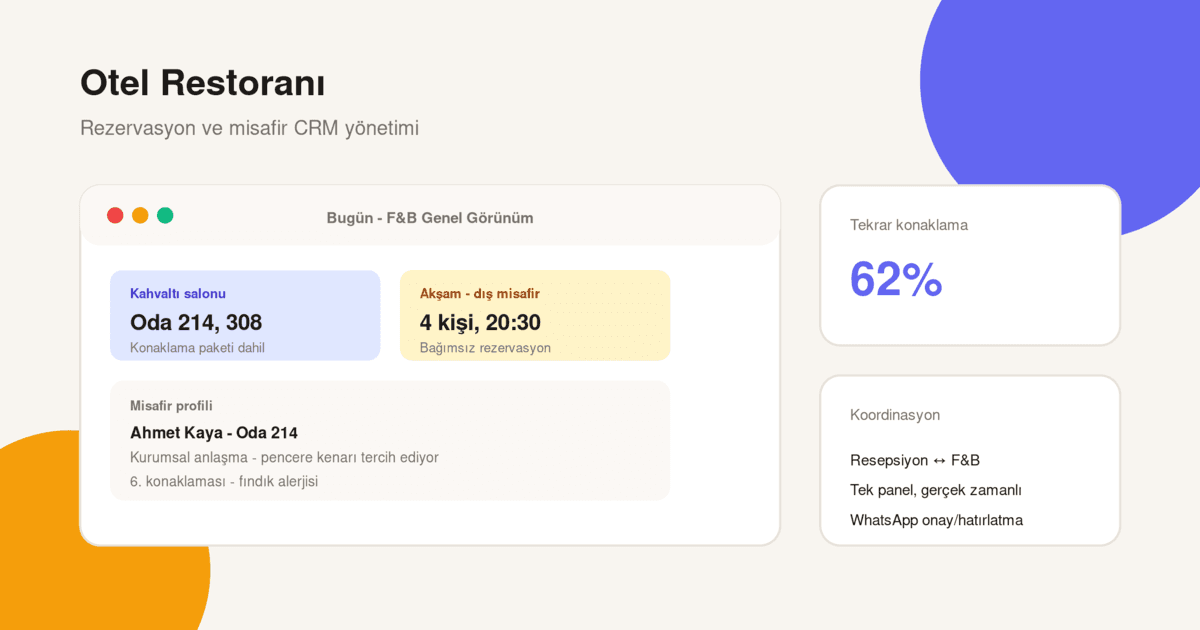
Reservation and Guest CRM Management for Hotel Restaurants
A guide to managing in-house and walk-in guests, breakfast-lunch-dinner peaks, and front-desk/F&B coordination in one system for hotel restaurants.
A hotel restaurant operates under a different equation than a standalone restaurant: it serves in-house guests (breakfast tied to room number and package) and outside à la carte guests at the same time. When information does not flow correctly between front desk, F&B, and the kitchen, the breakfast room gets overcrowded, or an outside booking clashes with room stays.
This article explains how hotel restaurants can set up reservations and guest CRM, separate in-house from outside guests, and simplify front-desk/F&B coordination.
1. The unique reservation challenges of hotel restaurants
A hotel restaurant runs three service windows at once: breakfast (usually included in the stay package), lunch (business meetings, local guests), and dinner (both in-house and outside guests, sometimes special events). Each window has its own capacity and demand pattern.
The breakfast room is typically planned around room count, though occupancy is rarely 100%; meanwhile weekend à la carte dinner can see heavy outside demand. Managing both demands with the same floor plan and logic either wastes capacity or overbooks it.
- Breakfast: tied to room count, included in the stay package
- Lunch: business meetings, local guest traffic
- Dinner: both in-house and outside guests, special events
- Each window has a distinct capacity and demand pattern
2. Separating in-house (room number) and outside guest bookings
An in-house guest’s booking is tied to a room number, stay dates, and package terms (breakfast included, half board, etc.). An outside guest’s booking follows an independent payment and cancellation policy.
Keeping these two booking types indistinguishable in the same list causes confusion during service — for example, offering to charge an outside guest to a room account, or mistakenly asking an in-house guest for payment.
- In-house guest: room number, package type, stay date range
- Outside guest: independent payment, standard cancellation policy
- Clear separation by type in the booking list
- Room charging only for verified in-house guests
3. Capacity and floor planning for breakfast and peak hours
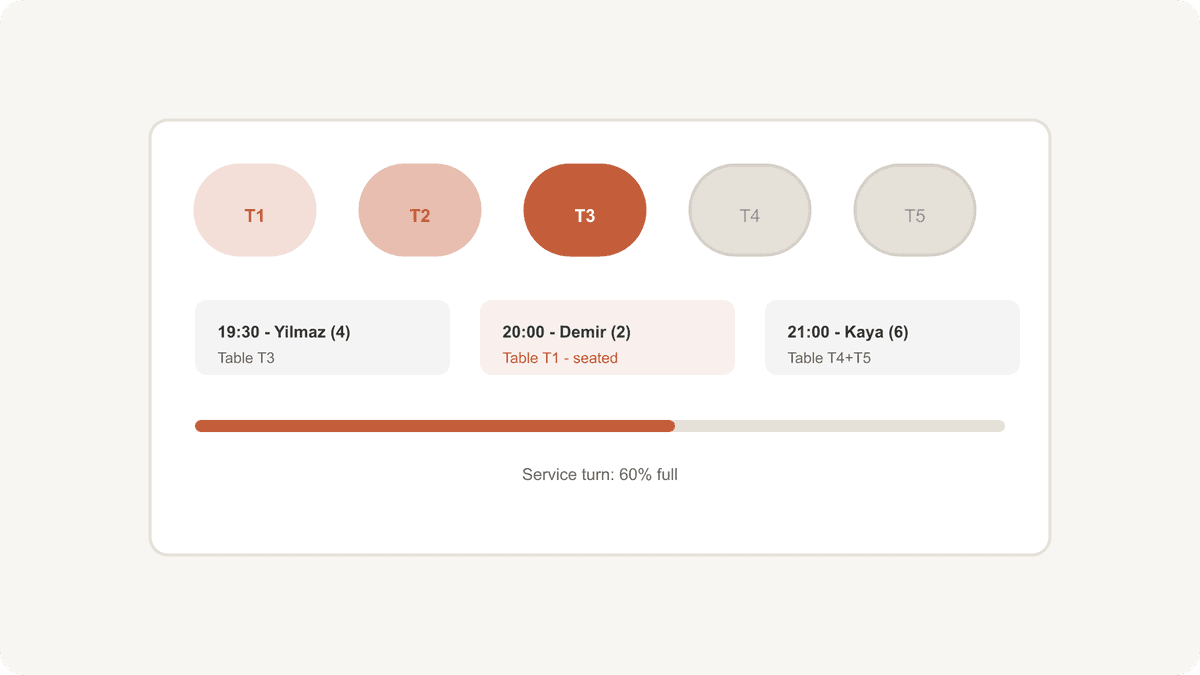
Breakfast demand between 7am and 10am usually clusters near check-out time. Planning room capacity around this peak, and defining a separate table block for late breakfast, improves guest satisfaction and balances staff workload.
For lunch and dinner, it is healthier to manage outside à la carte bookings with a separate capacity logic rather than the same pool used by in-house guests.
- Plan breakfast demand around check-out timing
- Separate table block for late breakfast
- Separate capacity for outside lunch/dinner bookings
4. Hotel guest CRM: loyalty, repeat stays, VIP notes
A hotel restaurant’s key advantage is that guests return repeatedly during a multi-day stay — a far richer opportunity to build a guest profile than most standalone restaurants get. A guest’s preferred breakfast table, the wine ordered at dinner, or a noted allergy should be remembered throughout the stay.
For loyal, frequent guests — corporate accounts, regular business travelers — VIP notes and preference history should live in a record shared by both F&B and front desk.
- Preferences (table, menu, allergens) remembered throughout the stay
- VIP notes and history for corporate/frequent guests
- F&B and front desk share access to the same guest record
5. Coordinating front desk, F&B, and WhatsApp
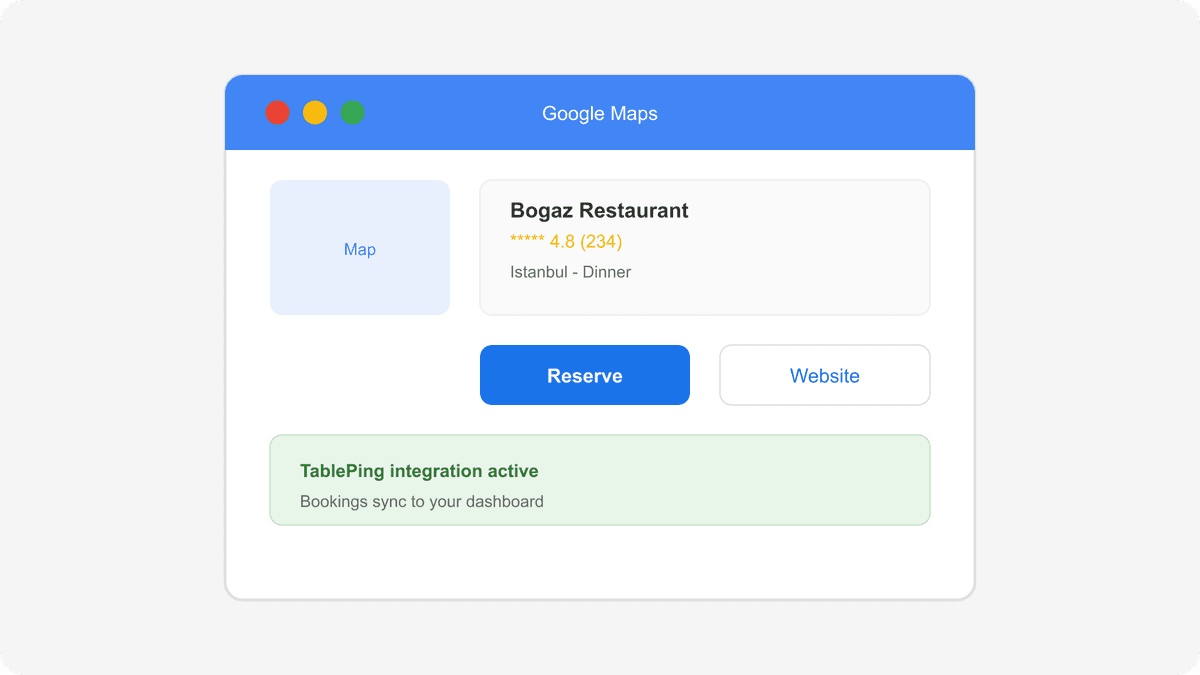
Reservation requests at hotel restaurants can arrive through three channels: the front desk phone, WhatsApp, and an in-hotel app or form. When these channels are disconnected, the same table can be double-booked, or a request can go unprocessed entirely.
Consolidating every request into one panel — regardless of source — lets the front desk book a dinner reservation for an in-house guest while F&B sees real-time capacity. WhatsApp confirmations and reminders strengthen communication without opening an extra channel for guests.
- Requests from every channel consolidate into one panel
- Front desk sees real-time capacity while booking
- WhatsApp confirm/remind works without adding a new guest channel
6. Running hotel restaurant operations with TablePing
TablePing brings in-house and outside guest bookings, breakfast and à la carte capacity, and the guest CRM record into one panel. Room information and package terms for in-house guests stay clearly separate from independent outside bookings.
The guest profile remembers preferences throughout the stay and on future visits, so F&B and front desk deliver consistent service from the same record.
- Reservation management with in-house/outside separation
- Separate capacity definitions for breakfast, lunch, and dinner
- Guest CRM: preferences, allergens, VIP notes
- Automated WhatsApp confirmation and reminders
A hotel restaurant has to manage three service windows and two guest types under one roof. Separating in-house from outside guests, planning breakfast around check-out timing, and consolidating front-desk/F&B coordination into one panel protects capacity and keeps the guest experience consistent.
Manage the whole process on one platform with TablePing and start with a free trial.